Fake Alert: How to Spot Real Amethyst in 2026 (5 Professional Tests)

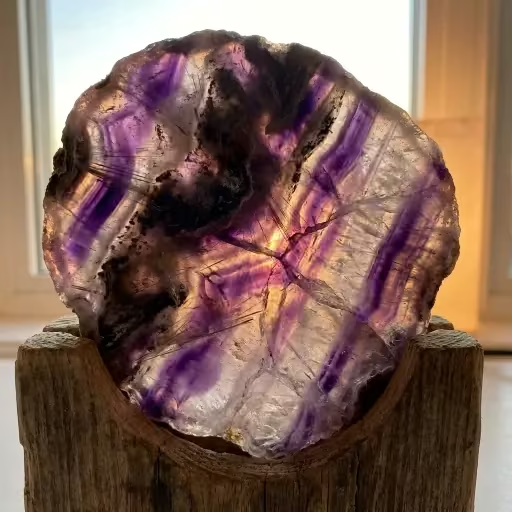
Here is a scary stat: In 2025, the market was flooded with lab-grown purple quartz and dyed glass sold as “Natural Amethyst.”
I’ve seen it on Etsy. I’ve seen it on TikTok Shop. And frankly, it makes my blood boil. You aren’t buying a crystal for a pretty purple paperweight; you are buying it for its energy. Glass has no geological history. It has no vibration.
If you are holding a piece of Amethyst right now (or thinking about buying one), how can you be 100% sure it came from the Earth and not manufacturing in a factory?
As a crystal jewelry designer who looks at thousands of kilos of stones a year, I’m going to teach you the exact 5 tests I use to spot a fake in seconds.
The “Big 3” Fakes on the Market
Before we test, you need to know what you’re up against.
- Dyed Glass: Just plain glass injected with purple dye.
- Synthetic Quartz (Hydrothermal): Chemically identical to quartz but grown in a lab in 2 weeks (not millions of years). Perfect clarity, zero soul.
- Baked Citrine/Amethyst: Sometimes they sell low-grade amethyst, heat it, and call it Citrine. Or dye clear quartz purple.
Test 1: The Bubble Test (The Easiest Giveaway)
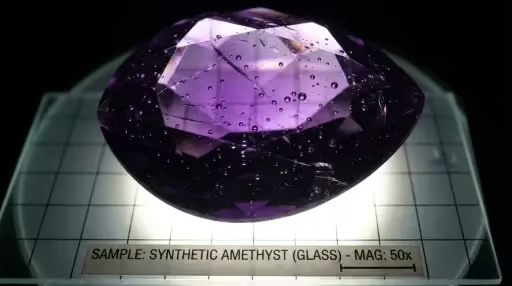
Grab a magnifying glass (or just use your phone camera on 3x zoom). Look inside the stone.
- FAKE: Do you see tiny, perfectly round bubbles? That is air trapped during the glass cooling process. Real quartz never has round bubbles.
- REAL: You might see “imperfections” like white streaks, feathers, or tiny black specks. These are good! They are nature’s fingerprint.
Test 2: The Color Zoning Test (The “Ugly” Truth)
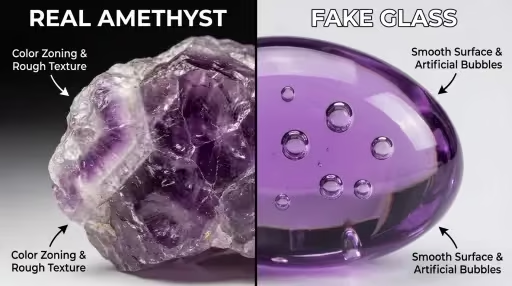
If your Amethyst is a perfect, uniform shade of purple all the way through… I have bad news. It’s likely synthetic.
Real Amethyst is messy. It has what we call Color Zoning.
- Hold it up to the light. You should see bands of darker purple, lighter lilac, and maybe even clear or white quartz layers.
- Nature is rarely uniform. If it looks like a purple jolly rancher, it’s fake.

Test 3: The Temperature Test
Crystals are excellent heat conductors.
- The Test: Touch the stone to your cheek or inner wrist.
- REAL: It should feel ice cold instantly, and it will take a minute to warm up to your body temperature.
- FAKE (Glass/Plastic): It will feel room temperature or warm up immediately.
🔗 Expert Source: This property is due to the thermal conductivity of crystalline structures. Read more about Thermal Conductivity of Gemstones on GIA.
Test 4: The Scratch Test (Mohs Hardness)
Amethyst is a variety of Quartz, which ranks a 7 on the Mohs Hardness Scale. This means it is harder than glass (5.5) and a steel knife (6.5).
- The Test: (Do this on the bottom of the stone!). Try to scratch the crystal with a steel knife or a piece of glass.
- REAL: The knife should not leave a scratch on the Amethyst. In fact, the Amethyst should be able to scratch a glass plate.
- FAKE: If the knife digs in, it’s plastic or soft glass.
Test 5: The Origin Check
Ask the seller: “Where was this mined?” If they say “I don’t know”, be wary. Most high-quality Amethyst comes from:
- Brazil: Usually lighter, larger geodes.
- Uruguay: The deep, dark, grape-jelly purple (most expensive).
Madagascar: Often has hematite (red) inclusions.
At ZodiacCryst, we source primarily from Uruguay for that deep energetic vibration.
Summary: The “Real Amethyst” Checklist
| Feature | Real Amethyst ✅ | Fake Amethyst ❌ |
|---|---|---|
| Inclusions | Feathers, streaks, zoning | Round bubbles |
| Color | Uneven, banded | Perfect, uniform |
| Temp | Cold to touch | Warm / Room Temp |
| Price | Reasonable ($10-$100+) | Suspiciously cheap ($2) |
Shop with Confidence
Don’t gamble with your energy. Every single piece at ZodiacCryst is hand-inspected and guaranteed 100% natural. We don’t sell glass. We sell Earth.
6 thoughts on “Fake Alert: How to Spot Real Amethyst in 2026 (5 Professional Tests)”